

Breaking news in Vancouver doesn’t arrive the way it did even two years ago. In 2026, major Canadian outlets like The Vancouver Sun, The Star, and National Post have shifted to dedicated breaking news hub pages that aggregate headlines throughout the day, while international platforms like Yahoo News and Ground News funnel global and local stories into a single stream. The days of waiting for a 6 p.m. broadcast or tomorrow’s paper are long gone, but so is the era of scattered social media posts. What we’ve got now is a hybrid model where short-format updates, curated feeds, and hyperlocal alerts compete for your attention, and knowing which sources deliver Vancouver-specific context versus recycled wire copy makes all the difference.
This feels different now because the delivery mechanism has fundamentally changed. Canadian news sites have adopted real-time headline pages that refresh constantly, while apps like Hindustan Times have popularized bite-sized news formats that prioritize speed over depth. For Vancouver readers juggling housing crises, transit delays, and climate events, the challenge isn’t finding breaking news. It’s filtering signal from noise, understanding who’s reporting with local expertise, and recognizing when a national headline actually affects your commute, your neighbourhood, or your next council meeting. This guide breaks down what’s shifted in 2026, which developments matter for local news consumers, and what to watch as the breaking news landscape continues to evolve.
What Changed: The Breaking News Landscape in 2026

The breaking news ecosystem in Canada underwent a structural overhaul between 2024 and 2026, moving away from scattered alerts and homepage carousels toward purpose-built headline hubs. Major outlets, The Star, Vancouver Sun, National Post, now route readers to dedicated “Breaking News, Headlines and Stories” pages that consolidate updates in a single stream, a shift that reflects both audience behaviour and the sheer volume of news events demanding attention. Instead of hunting through category pages or relying on push notifications that may arrive hours apart, readers get a centralized feed that updates throughout the day.
This consolidation answers a practical problem: information overload. With dozens of stories breaking simultaneously across politics, weather, public safety, and international affairs, newsrooms needed a structure that could prioritize without burying critical local developments under national headlines. The Digital News Report 2026 found that readers increasingly prefer a single destination for breaking news over fragmented social feeds, a preference Canadian outlets have now codified into their site architecture.
Aggregators joined the shift. Ground News launched a Canada-specific breaking news page that blends national and provincial headlines, while Yahoo News built out a model that pairs “breaking news stories and in-depth coverage” side-by-side, recognizing that some readers need a 30-second headline while others want context. Short-format apps like Hindustan Times doubled down on brevity, offering breaking headlines in digestible chunks for mobile-first audiences. The result is a two-tier system: rapid-fire updates for those tracking multiple stories, and deeper reporting for readers who need to understand what a headline actually means.
Key Developments Reshaping Breaking News
1. Dedicated Breaking News Hub Pages Across Major Outlets
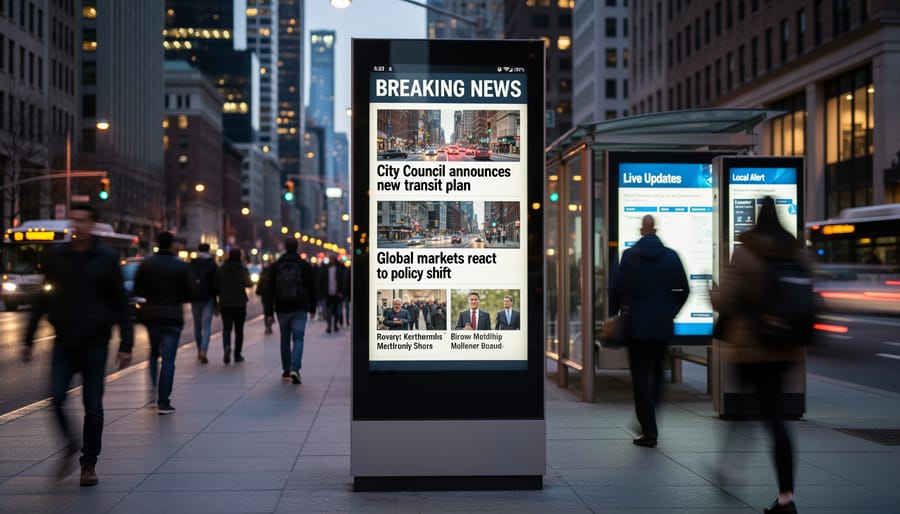
Canada’s major news organizations restructured their breaking news delivery in 2026 around centralized hub pages that consolidate headlines in one place. The Star, Vancouver Sun, National Post breaking news and Ground News Canada all now maintain dedicated breaking news sections where readers land directly on the latest developments without navigating multiple category pages. This shift recognizes that readers want immediacy: a single destination for breaking updates rather than hunting through sports, politics, and local sections individually.
For Vancouver readers, this means The Star and Vancouver Sun pages surface both national headlines and local breaking stories side-by-side, a shooting in Surrey appears alongside federal policy announcements, all timestamped and prioritized by recency. Ground News Canada’s hub page adds another layer by aggregating breaking headlines from multiple outlets, letting readers compare how different newsrooms frame the same story. The hub model serves two needs: speed for readers checking headlines during a commute, and depth for those who want to drill into full coverage. You’re no longer piecing together what’s happening from scattered sources; the architecture assumes you’re starting at the breaking news page and want the overview first, details second.
2. Short-Format Breaking News Delivery
The dual-headline model has become standard this year: readers want the five-word flash and the five-minute explainer, and platforms now serve both at once. Yahoo News exemplifies this split, offering Yahoo News breaking updates alongside longer analysis pieces on the same page, you scan the top line, then decide whether you need the full story. Hindustan Times took it further with breaking news headlines delivered in deliberate short formats, stripping each alert to its core without losing context. This isn’t dumbing down; it’s acknowledging that breaking news competes with texts, emails, and a dozen other tabs.
For Vancouver readers, the shift means you’re not stuck choosing between a three-paragraph teaser and a sprawling longread when a councillor resigns or a storm warning drops. The Star, Vancouver Sun, and National Post all layer quick-hit headlines over deeper coverage, letting you triage information in real time. You get the gist in seconds, then drill down if the story affects your commute, your neighbourhood, or your evening plans. The trade-off? Speed can outpace nuance, and a condensed headline sometimes smooths over necessary friction, what got cut matters as much as what stayed. The format works when outlets trust readers to move between layers, not when they treat short as a substitute for complete.
3. Global-to-Local Breaking News Aggregation

The rise of global aggregation platforms has fundamentally reshaped how Vancouver readers encounter breaking news. Services like World News and the Ground News Canada page now pull international headlines alongside Canadian and BC-specific stories, creating a split-screen experience where a local housing policy announcement might sit next to Middle East conflict updates or European climate developments. For readers who want both hyper-local context and awareness of global events, this blended approach eliminates the need to toggle between multiple apps or bookmarks, everything lands in one feed.
The trade-off is cognitive load. When every update competes for attention, it’s harder to distinguish which stories actually affect your neighbourhood, your commute, or your immediate decisions. Ground News attempts to address this by highlighting source bias and story coverage patterns, giving readers at least some transparency about how a given headline is being framed across outlets. For community activists and young professionals who need to stay informed both locally and globally, these aggregators work best as triage tools, quick scans to catch what’s breaking, followed by deep dives into trusted local sources when a story demands more context or directly impacts Vancouver.
Why This Matters for Vancouver News Consumers
For Vancouver residents juggling work, activism, and community life, the 2026 breaking news ecosystem creates both opportunity and friction. The shift to centralized hub pages and short-format delivery means you can scan headlines faster, but it also amplifies a problem Vancouver needs to know: the sheer volume of breaking news now competing for your attention makes it harder to separate genuinely local stories from global noise repurposed as urgent. When every outlet pushes real-time updates, the risk isn’t missing a story, it’s drowning in headlines that look critical but offer little context or local relevance.
- Local stories get buried under global headlines aggregated by the same platforms serving Vancouver news
- Speed incentives push outlets to publish incomplete information, requiring readers to cross-check sources later
- Hub pages centralize access but rarely prioritize hyperlocal beats like municipal policy or neighborhood developments
- Short-format delivery reduces context, making it difficult to assess whether a breaking headline affects Vancouver directly
This matters because Vancouver’s news landscape depends on readers who can distinguish between a trending national story and a development that impacts transit, housing, or local governance. Community activists tracking city council decisions or neighborhood issues need reliable local sources that don’t dilute coverage with generic breaking news. Young professionals want speed but also accuracy, there’s no value in a headline that updates three times before the facts are clear. The balance between immediacy and trustworthiness has always been tension in journalism, but in 2026, that tension lands squarely on readers who must now curate their own breaking news diet from a fragmented, high-volume ecosystem.
What to Watch: The Future of Breaking News Headlines
The breaking news ecosystem isn’t done evolving, what you see on hub pages and short-format feeds in 2026 is a snapshot, not the final version. Three shifts are already underway.
First, reader participation in breaking news is gaining traction beyond simple comment threads. Some Canadian outlets are testing community fact-checking features where locals flag inaccuracies or add missing context to developing stories. Vancouver readers already know to verify sources when claims spread fast on social feeds; soon, that verification step may be built into the news page itself, with community notes appearing alongside journalist updates.
Second, hyper-local breaking news is filling the gap left by shrinking newsrooms. Neighbourhood-level alerts, road closures, building fires, police incidents, increasingly come from residents posting real-time updates before reporters arrive. Outlets that figure out how to curate and verify these community-driven updates without sacrificing accuracy will own the local breaking news space.
Third, the line between aggregator and publisher is blurring. Sites like Hush News sit at the intersection: we cover breaking stories that matter to Vancouver while also pointing readers toward credible sources for broader context. As hub pages proliferate and algorithms push identical headlines everywhere, the outlets that survive will be the ones offering distinct angles, local relevance, and a voice you actually trust. Watch for more publishers adopting that hybrid model, breaking news with perspective, not just speed.
Reader Questions on Breaking News in 2026
How do I know if a breaking news headline is reliable?
Check if the story appears on established Canadian news sites like The Star, Vancouver Sun, or National Post, and look for multiple sources reporting the same facts before sharing or reacting. Be skeptical of headlines that rely heavily on unnamed sources or lack specific details.
What’s the difference between breaking news hubs on different sites?
Major outlets like The Star and Vancouver Sun curate their own reported breaking stories, while aggregators like Ground News Canada collect headlines from multiple sources. The hub pages serve different purposes: one gives you a single editorial perspective, the other offers comparison across outlets.
How can I follow Vancouver-specific breaking news?
Set up alerts through the Vancouver Sun’s breaking news page for mainstream coverage, and follow local outlets and community journalists on social media for neighbourhood-level updates. Balancing both gives you city-wide context and hyper-local detail.
The FAQ format reflects how readers actually search for breaking news guidance in 2026. Most questions boil down to trust, source comparison, and local relevance. Vancouver readers want practical answers they can act on immediately, not theory about information ecosystems. The mix of mainstream and community sources mirrors how news consumption actually works here: you need the Vancouver Sun for verified city hall announcements and Hush News for the neighbourhood angle the bigger outlets miss.